
DRIVING IN CALAIS
Driving in Calais: what British motorists need to know
Driving in Calais: what British motorists need to knowDriving in Calais is not especially difficult, but the first few junctions after leaving the ferry or LeShuttle deserve attention. You are immediately driving on the right, approaching roundabouts from the opposite direction and reading unfamiliar French road signs.
Last checked: September 2026. This is a practical visitor guide, not a complete statement of French traffic law.
Set your destination before leaving the terminal, keep right after every turn and take the first roundabouts slowly. Once you have adjusted, Calais is generally straightforward to drive around.
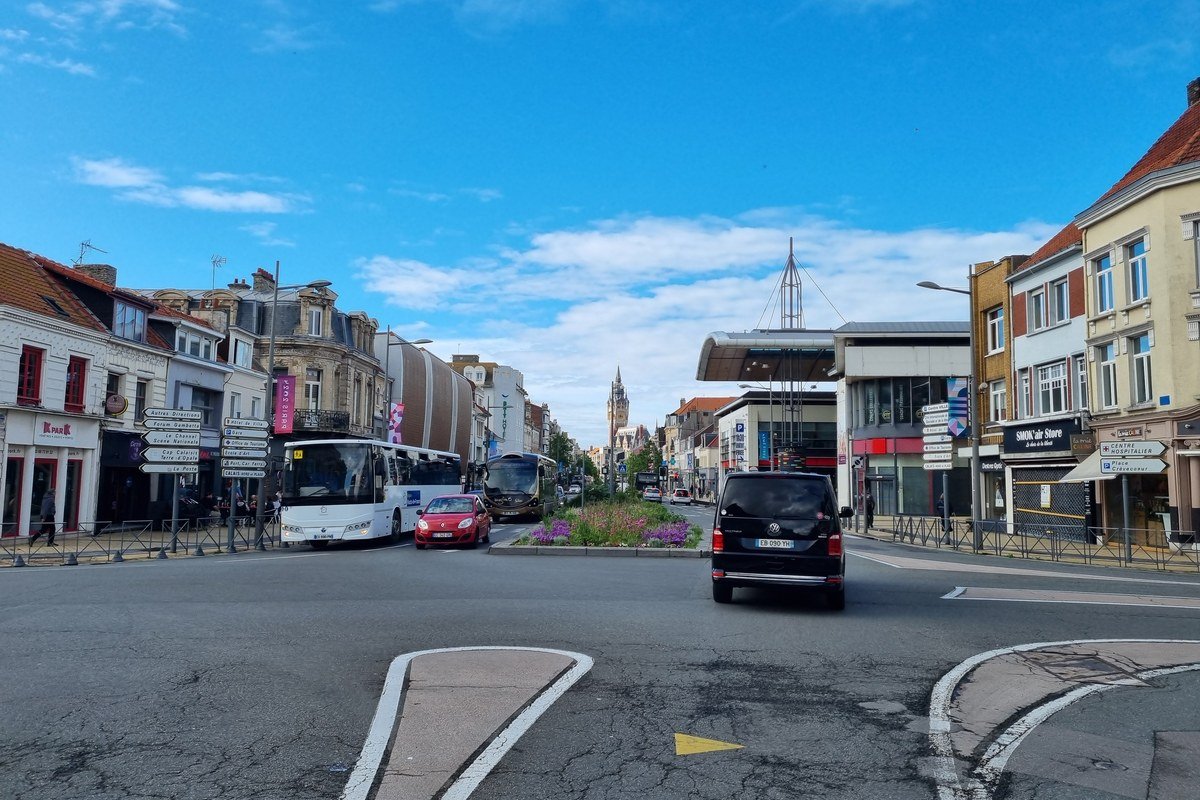
The first ten minutes after arriving
Most British drivers make mistakes when traffic is light rather than busy. With no vehicle directly ahead, it is easier to turn onto the wrong side of an empty road.
After leaving the Calais ferry port or LeShuttle terminal:
- Keep right after every turn.
- Approach roundabouts from the right-hand side of the road.
- Travel anticlockwise around roundabouts.
- Use your left-hand mirror before moving out or overtaking.
- Check for cyclists before turning right.
- Do not stop on terminal exit roads to adjust navigation.
Ask them to remind you to keep right after stops and turns. The risk of reverting to the left increases when restarting after lunch, shopping or refuelling.
Driving from the ferry port
The ferry terminal connects quickly with the main road network. Follow the port exit signs until you are outside the controlled terminal area.
From there, choose between:
- Centre Ville: central Calais and the Town Hall.
- Calais Plage: the beach and seafront.
- A16: Coquelles, Boulogne-sur-Mer, Dunkirk and Belgium.
- A26: Arras, Reims and routes deeper into France.
If you are stopping immediately after arrival, Carrefour Mi-Voix is a convenient supermarket. For a larger shopping stop, continue towards Cité Europe.
Driving from the LeShuttle terminal
LeShuttle arrives in Coquelles, beside the A16. This makes it easier to continue directly into France without entering Calais.
Cité Europe is approximately five minutes from the terminal. Central Calais and the beach require a separate turn away from the motorway.
When returning to LeShuttle, follow signs for Tunnel sous la Manche and then Terminal tourisme. Do not follow Terminal fret, which is for freight traffic.
How French roundabouts work
Most modern French roundabouts work in the way British drivers expect, apart from the direction of travel. Vehicles entering give way to traffic already on the roundabout when you see a triangular give-way sign or Cédez le passage markings.
However, France also retains the rule known as priorité à droite, or priority from the right. At a junction without signs or markings, a vehicle approaching from your right may have priority.
Do not assume that every circular junction follows identical rules. Read the signs and road markings on approach.
Useful roundabout routine
- Reduce speed early.
- Check the signs and lane arrows.
- Look left for traffic already circulating.
- Enter and travel anticlockwise.
- Signal right before taking your exit.
- Check for cyclists beside you before leaving.
Typical French speed limits
The signed limit always takes priority. As a general guide for cars in normal conditions:
Limits can be lower in rain and poor visibility. Around Calais, pay particular attention to changing limits on port approaches, shopping-centre roads and the transition between the A16 and urban streets.
Remember that 50 km/h is approximately 31 mph, while 130 km/h is approximately 81 mph.
Priority from the right
Priority from the right is most relevant on smaller streets and unsigned junctions. If there is no stop sign, give-way sign or clear priority road marking, traffic emerging from a road on your right may have priority.
A yellow diamond sign indicates that you are travelling on a priority road. The same diamond crossed by a black diagonal line shows that this priority is ending.
You do not need to memorise the entire French road-sign system for a short visit, but you should avoid driving through an unsigned junction on the assumption that the larger road automatically has priority.
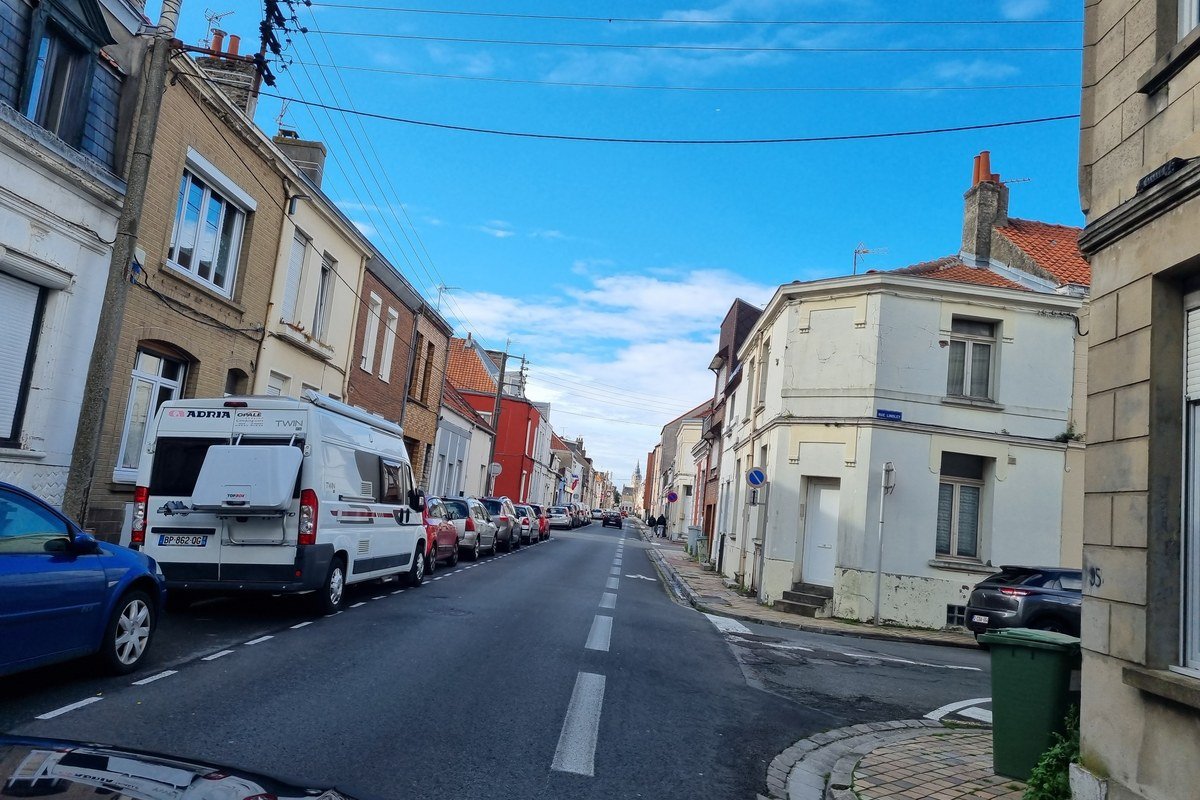
What must you carry in the car?
Before leaving Britain, check the current legal requirements for driving in France. Depending on your vehicle and circumstances, these may include:
- A valid driving licence.
- Your vehicle registration document, usually the V5C.
- Valid motor insurance.
- A warning triangle.
- A reflective high-visibility jacket accessible from inside the vehicle.
- Headlamp adjustment or converters where required.
- A UK identifier if your number plate does not already meet the applicable requirements.
If you break down, you need to put it on before leaving the vehicle. Keep it in the glovebox, door pocket or another accessible place.
Check the current UK government driving-abroad guidance before travelling. Equipment and documentation rules can change.
UK stickers and number plates
You may need a separate UK sticker if your number plate displays GB, an English, Scottish or Welsh national flag, a Euro symbol, or no national identifier.
A number plate that already displays the UK identifier with the Union flag normally does not require a separate sticker in France. Check the current government guidance for the exact rules applying to your vehicle.
Headlights and visibility
British headlights can dazzle drivers when used on the opposite side of the road. Depending on the vehicle, you may need headlamp beam converters or a built-in tourist mode.
Modern vehicles sometimes allow the beam pattern to be changed through the dashboard settings. Check the handbook before travelling rather than attempting to work it out beside the ferry terminal.
Speed cameras and navigation equipment
France uses fixed and mobile speed enforcement. Devices intended to detect or warn specifically of speed-camera locations are restricted.
Navigation applications may automatically change how they present safety or enforcement zones in France. Do not bring dedicated radar-detection equipment.
The simplest rule is to follow the displayed speed limit, particularly where the limit reduces near towns, roadworks or toll areas.
Using a mobile phone
Do not hold or use a mobile phone while driving. Set the route before moving and use a securely mounted device if navigation is necessary.
French restrictions also extend beyond simply holding a telephone. Wearing headphones or earphones while driving is prohibited, including a single earpiece.
Alcohol limits
French drink-driving limits are stricter than those applying in most of the UK. The safest approach is not to drink at all when driving.
This matters in Calais because visitors often combine lunch with wine or beer shopping before returning to the terminal. Having alcohol in the boot is not the issue; consuming it before driving is.
Parking in Calais
Parking is free across most of Calais, but some spaces are inside time-limited blue zones. These require a parking disc showing your arrival time.
The simplest choices are:
- Seafront parking for Calais beach.
- Place du Soldat Inconnu for the Town Hall and belfry.
- Place d’Armes or the marina parking areas for Calais Nord.
- The large free car park at Cité Europe for shopping.
See our complete parking in Calais guide for blue zones, motorhomes and ferry-terminal parking.
Fuel and service stations
French fuel names differ slightly from those used in Britain:
- Gazole: diesel.
- Sans plomb 95 or SP95: unleaded petrol.
- SP95-E10: unleaded petrol containing up to 10% ethanol.
- SP98: higher-octane unleaded petrol.
- GPL: LPG.
Check which fuel your vehicle accepts before using an unattended pump. Many automated pumps request a card authorisation that can temporarily appear as a larger pending amount in your bank account.
Low-emission zones and Crit’Air stickers
French cities can operate permanent or temporary low-emission restrictions using the Crit’Air windscreen sticker system. Requirements depend on the city, vehicle and any temporary pollution measures.
Even if you are only passing through Calais, check the rules for your onward destination. Lille, Paris and other urban areas may have different requirements from Calais.
Only order a Crit’Air sticker through the official French government website. Unofficial intermediaries may charge considerably more.
Driving back to Britain
Allow enough time for check-in and border formalities. Do not use the scheduled departure time as the time you need to reach the terminal.
- For the ferry, follow signs for Terminal Car Ferry.
- For LeShuttle, follow Tunnel sous la Manche and Terminal tourisme.
- Check your operator’s latest required arrival time.
- Expect more traffic during school holidays and major travel weekends.
The Calais ferry-port guide has the terminal address and approach information.
Our advice for a first drive in Calais
Calais is a manageable place to make your first French drive. The main roads are broad, the terminals connect directly with the A16 and most visitor destinations have straightforward parking.
The key is to remove distractions during the first few minutes. Start navigation before moving, keep right after every turn and let the new road position become familiar before searching for shops or attractions.
Road rules were checked against official British and French government guidance in September 2026. Road signs and instructions from police or terminal staff always take priority.