
MUSEUMS AND SIGHTS
Is the Musée des Beaux-Arts in Calais worth visiting?
This compact, free art museum is one of the better indoor stops in central Calais. Its strongest section explains Rodin’s Burghers of Calais, a monument with a direct connection to the town’s history with England.
Practical information checked September 2026
Is it worth your time?
Yes, particularly if you are interested in Calais rather than simply looking for a large general art museum. The collection is manageable, admission is free and you do not need to give up half a day to see it properly.
The museum works especially well when the weather is poor or when you have a few hours before your ferry. It is not an essential stop for every visitor, but it is more relevant to Calais than its fairly plain exterior suggests.
Our verdict
Visit for the Rodin material and the local context. Allow around an hour unless a temporary exhibition particularly interests you. If you only have one hour in Calais altogether, remain outdoors and see the original monument at the Town Hall instead.
What is inside?
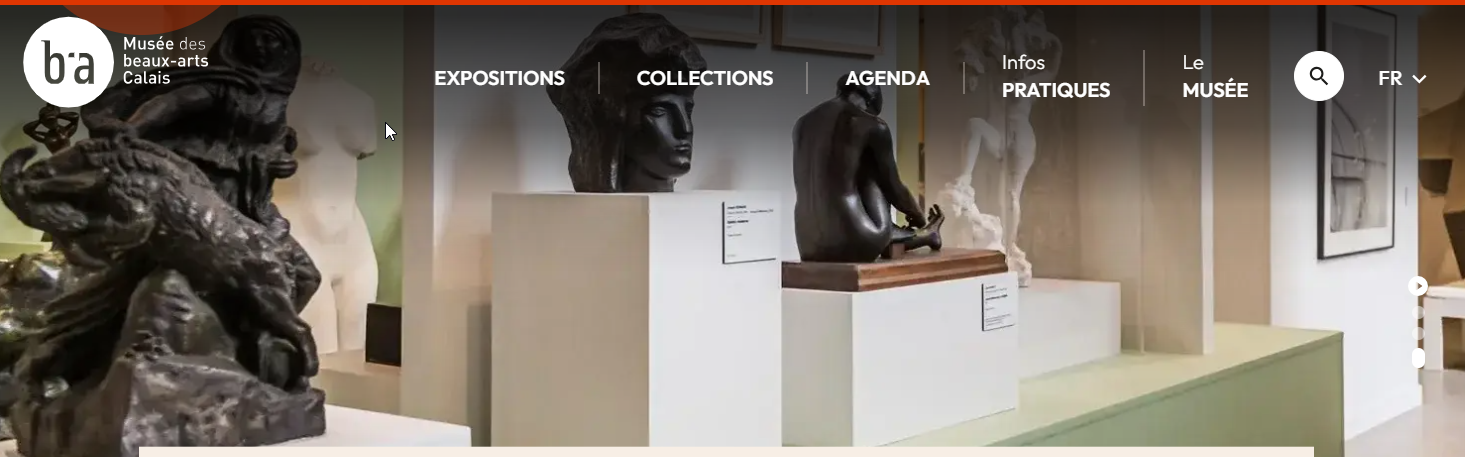
The permanent collection includes paintings, sculptures, drawings and photography from the sixteenth century through to contemporary art. Exhibitions may change, so the precise mix is not always the same.
For a first-time visitor, the most distinctive part is the material connected with Auguste Rodin and The Burghers of Calais. Studies and sculptures show how Rodin developed the figures and why the finished monument looked so different from a conventional heroic memorial.
The Burghers of Calais explained
The story dates from the siege of Calais in 1346–47 during the Hundred Years’ War. According to the traditional account, six prominent citizens offered themselves to the English king Edward III in return for sparing the population.
Calais commissioned Rodin to create a monument to the six men in 1884. Rather than presenting them as triumphant heroes, he showed six separate individuals facing fear, uncertainty and resignation.
The completed bronze monument stands outside Calais Town Hall and Belfry. Seeing the museum and monument together makes considerably more sense than treating them as two unrelated attractions.
A good short Calais combination
The museum is in the town centre and can easily be combined with several nearby sights. A sensible route is:
- Visit the Musée des Beaux-Arts.
- Walk to the Town Hall and see Rodin’s monument outside.
- Continue towards Parc Saint-Pierre or the main shopping streets.
- Finish with lunch or coffee in central Calais.
This combination fits comfortably within our two-to-four-hour Calais itinerary, provided you check the museum’s opening hours first.
Opening hours and admission
Admission to the permanent collection is currently free. The museum is normally closed on Mondays, but opening times vary between weekdays, weekends and seasons.
Do not rely on the times from an old travel article, especially for a Sunday or winter visit. Check the official Musée des Beaux-Arts website before setting off.
Useful for a Sunday visit
The museum can be one of the more useful Sunday activities in Calais, when many ordinary shops are closed. Confirm that it is open on your particular date before building your day around it.
Getting there
The museum is at 25 Rue Richelieu, 62100 Calais, within the central part of the city. It is more naturally combined with the Town Hall and centre than with the suburban shopping area around Cité Europe.
Drivers should use one of the central parking areas rather than trying to stop directly outside. See our Calais parking guide before entering the centre.
If you arrive as a foot passenger, the museum is also a realistic attraction without a car. Our guide to Calais without a car explains how to get around from the station and ferry port.
Who should visit?
- Visitors interested in Rodin or the history of Calais.
- Anyone looking for an indoor activity in poor weather.
- Foot passengers exploring the centre without a car.
- Families with older children who enjoy history or art.
- Travellers with two to four hours before their crossing.
Who can probably skip it?
If your main reason for stopping is shopping, food or the beach, do those first. The museum is also unlikely to be the best use of a very tight stop immediately after leaving LeShuttle, because it requires driving into the centre.